
Content Description
jchxkj
1. Pre-History
1.1 The Niger-Congo Era
1.1.1 Circa 8000 B.C.E.
The Niger-Congo speakers developed unique planting techniques, which enabled them circa 8000 B.C.E. to domesticate crops like yams, okra, oil palms, black-eyed peas, and guinea fowl.
1.1.2 Circa 6000 B.C.E.
Late in the sixth millennium and early fifth millennium B.C.E., the Niger-Congo peoples were spreading out of southern Nigeria into parts of present-day Cameroon and the Central African Republic. The fertile volcanic soils of this region allowed for increased agricultural production. The novelty of distinct soils and different environments opened the opportunity for innovation
By the sixth millennium B.C.E., the elaboration of farming techniques and climatic conditions had led to increased populations. Increased population densities led to the spread of ideas and culture as the Niger-Congo peoples began to spread southward into the rain forest and across the woodland savanna into the Atlantic coast hinterland. In the fourth millennium B.C.E., one major subgroup of Niger-Congo, speakers of Bantu languages, were spreading into the forests of the Congo Basin.
1.2 The Emergence of Volta-Niger
Late in the sixth millennium and early fifth millennium B.C.E., the Niger-Congo peoples were spreading out of southern Nigeria into parts of present-day Cameroon and the Central African Republic. The fertile volcanic soils of this region allowed for increased agricultural production.
A sub-branch of Niger-Congo began to emerge between the sixth and fifth millennia B.C.E. as the Atlantic coast was settled. The Niger-Congo peoples were spreading out of southern Nigeria into parts of present-day Cameroon and the Central African Republic. The fertile volcanic soils of this region allowed for increased agricultural production. Far-flung communities developed different dialects. One sub-branch was the Benue-Kwa or Volta-Niger, the ancestral language of modern-day Yoruba, Igbo and Akan.
1.3 Circa 3000 B.C.E. - The Mande Spread
From 3000 to 1000 B.C.E., another group of Niger-Congo descendants, speaking Mande languages, spread through the Niger River Basin, where they cultivated rice. As the wet phase tapered off between about 2600 and 2000 B.C.E., drier open woodland savanna and grasslands expanded, allowing for another phase of agricultural expansion through innovative cultivation techniques.
1.4 The Ancient Benin Kingdom
There were many ancient human settlement areas, and from which many ethnicity trace their origins, for the Akalaka people, that place is in the land of the ancient Benin Kingdom. The ancient Benin kingdom represents ancient settlements and civilizations, a great and ancient people having been transformed through successive kingdoms of Idu, Igodomigodo and eventually Benin in the 1400s.
2. Who are the Akalaka.
The Akalaka Nation, made up of the Ikwerre, Ekpeye, Ogba, and Etche ethnicites are peoples mainly in present-day Rivers State, Nigeria, who trace their common ancestry to a single forefather named Akalaka who started a migration from their old settlements in ancient Benin land to their present locations, uniting with other similar peoples who they met that also trace their ancestors to the same origin. They regard themselves as one nation of distinct sub-ethnic families, not Igbo, and not Ijaw either. The Map below shows LGAs in Rivers State Nigeria, representing the Akalaka Core Area, the Ndoni, egbema and Engenni included in the administrative areas.
[MAP OF AKALAKA LAND]

The Akalaka Migration From Benin
Many communities in the Niger Delta were the products of migrations from ancient Benin land, one of such is Ale Iwere, which is today known as Warri, Alepe which became known as Nembe or brass-Ijaw (Leonard Glyn, p. 26) , and Ale Iwhuruohna, known as Akalaka-Ikwerre land.
3.1 The First Migrations - Wagidi
The first migration group was born out of a crisis / war in ancient Benin land, according to the oral history, It was this prolonged crisis that inspired outward migration by some groups. Wagidi, one of the notable and brave warriors of the Dynasty left with a group of loyalists to establish a new settlement. After many journeys, he settled at Elele, but he considered the place inhabitable. He left Elele and settled at Isiokpo. He expanded his new found territory between 1100 and 1140, and had a son called Okpo. Okpo in turn had Isi. Today, what is called Isiokpo is a combination of the two children of Wagidi - Isi and Okpo (Isi the son of Okpo). Isiokpo now is made up of the children of Isi. The town has witnessed the rulership of more than forty rulers starting from Wagidi in 1100 to His Royal Majesty (HRM) Nyewe Ali Blessing Wagor in 2005.

Table 1 — Early Rulers of Isiokpo (Extract)
S/N |
Names of Monarch |
Period of Reign |
Time Spent on Throne |
|---|---|---|---|
| 1st | Wagidi | 1100 - 1140 AD | 40 years |
|
2nd |
Okpo |
1140 - 1176 AD |
36 years |
|
3rd |
Isi or Isimwemen |
1177 - 1217 AD |
40 years |
|
4th |
Igodo or Wigodo |
1218 - 1249 AD |
31 years |
|
5th |
Osa |
1250 - 1287 AD |
38 years |
|
6th |
Oramanyah or Oram |
1289 - 1305 AD |
16 years |
|
7th |
Iyagbah |
1306 - 1337 AD |
31 years |
|
8th |
Okurukwuru |
1338 - 1373 AD |
36 years |
|
9th |
Owhe |
1374 - 1379 AD |
About 5 years |
|
10th |
Akwakah |
1380 - 1402 AD |
22 years |
Table 2 — The Five Most Recent Rulers of Isiokpo
S/N |
Names of Monarch |
Period of Reign |
Time Spent on Throne |
|---|---|---|---|
|
36th |
Imenwor |
1897 - 1927 AD |
30 years |
|
37th |
Amadi Okparanta |
1928 - 1930 AD |
About 2 years |
|
38th |
Wagor Imenwor
(Amadi Iyeh) |
1931 - 1948 AD
1949 - 1959 AD |
18 years
Regent on Spiritual Matters (10 years) |
|
39th
|
Jackson Aleruchi Mpi
Bekweri Iyeh |
1959 - 1973 AD
1973 - 2003 AD |
Regent on Civil and Political matters 14 years.
30 years |
|
40th
|
Blessing Wagor |
2005 - Present |
Current |
PHOTO - An Ikwerre Chief with his Wife, Nkarahia, Isiokpo, Akalaka-Ikwerre.

3.2 The Second Migration Wave
Centuries after the Wagidi migration, another migration took place in the fifteenth century. This migratory group was made up of Akalaka, Ochichi, and others during the reign of Oba Euare I the Great (1440 - 1473). Ekine (2013:14) noted that: The claims of consanguinity by the Ekpeye, Ikwerre and Ogba nations in their oral traditions should not be construed a mere coincidence hence, should not be discarded, rather it should be a guiding light in our search for the true origin and identity of these nations. Oba Ohen of Benin had two sons, Prince Ogun and Uwaifaikon. When their father died, the Uzama (kingmakers) appointed Uwaifaikon as Oba Ohen's successor. This must have angered Prince Ogun who was older than Uwaifaikon. Consequently, Prince Ogun was banished. It was from his house of exile that he acquired many magical powers in preparation for an attack. He eventually launched a deadly attack on his brother and took over the throne. Ekine (2013), Shillington (2005) and Egharevba (1960) stated that the new Oba took some revolutionary and retaliatory measures which are still respected in Benin up to the 21" century: He became Euare (Oworuare - the trouble has ceased). He changed the name from lle Ubini to Edo in memory of a royal servant who saved him during the royal crisis, adopted the right of primogeniture, expanded the empire through his 201 victories in war, rebuilt the capital city of the empire, and laid the foundation for what became a modern empire. In 1472, he met the Portuguese explorer, Ruyale Sequeira, and this marked the genesis of a long colonial relationship. He expanded the arts and carving industry, royal beautification with coral beads, institution of festivals like the Igue, and deification of some Obas. Sadly, when two of his sons - Kuoboyuwa and Ezuvagra died in a mysterious circumstance, he passed a decree forbidding sex for three years, forbade men from wearing shirt, and prohibited celebrations, bathing and dancing. By the time these obnoxious decrees were repealed due to a groundswell protest, many people who were not comfortable with these objectionable laws had left the empire for a new place. It is to his glory and memory that the current Oba of Benin took the title Euare ii.
Ekine (2013:8) asserted that: Oba Euare's vindictive policies enforcing a prolonged mourning
period for the loss of his two favorite sons were the final push factor, the final straw as it were, that led to renewed migration from Benin.
This was the scenario that necessitated the flight of Akalaka, Ochichi and others. It was believed that Oba Euare had earmarked Akalaka to be killed, but this plan was revealed to him by his sister. They ran to Agbor where Akalaka had his second son Ogba. It is important to state that Akalaka married the daughter of Obi of Agbor, and he named his second son Ogba in memory of his Ogba community in Benin. The group later settled at the fringes of river Sombriero at Obiebe. Solomon (2004) noted that Akalaka had three children, Ekpeye, Ogba and Iwhuruohna. It is likely that Akalaka was much older than the rest, and the leader of the group. He died in 1462 even before the other members of the group could reach their final destination.
4. Part of a Broader Mande Connection
Akalaka retains plenty edo words. Brief Language.
The Akalaka speak different languages corresponding to their ethnicities, such as Ekpeye, Ochichi, Ogba and Ikwerre languages.
Linguistically, over the years, many have judged the Akalaka language by its neigbours, however outside of its immediate neigbours, the Akalaka show shared elements of ancient Mande.
Infact the soninke and Bambara forms of greeting has been well preserved till this day by the Akalaka people and their mande kins. The Akalaka Iwu yala holds the same meaning as the Soninke and Bambara Iwu la. The follow up Akalaka word for yes, ‘Oweh’ unique to the Akalaka people is just as the mande ‘Aweh’
The Mande people occupy a vast region, more primarily the dominant population of Bambara and Soninke people of Mali. They are historicaly famous for Mansa Musa, one of the wealthies men in recorded history, and Sunjata Keita, who was the founder of the Mali Empire in West Africa in the early 13th century. Establishing a dynasty and suceeded by his son Mansa Wali.

4.2 Akalaka Music Instruments
In Mande civilization, the griot (in Mande languages, Dyeli, jeli or Jali) occupies a position of profound intellectual and spiritual importance. Far beyond the role of entertainer, the griot is simultaneously a historian, genealogist, musician, moral philosopher, and social mediator. The griot’s authority derives from the belief that speech itself embodies nyama, the vital energy that animates existence.
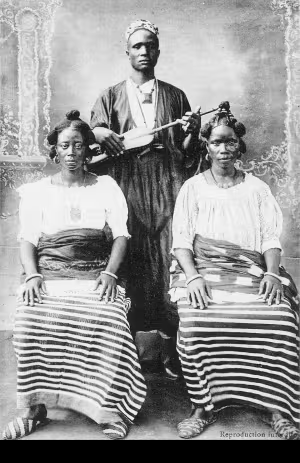
The relationship between Akalaka people and the Mande extends over several areas, one of such is in music. The Mande known for some of their innovative musical instruments, one of the earliest mention of it by Ibn Batutta 1325-1354, included what many agrees is the Ngoni, Xylophone, and Bow Lute or musical bow.
Similarly these forms the unique musical instruments of the Akalaka people of the Niger Delta. The Akalaka Ngoni located in museums and other instruments are shown below.
|
Image

|
Image

|
Image

|
|
Image

|
Image

|
The Akalaka xylophone is a unique musical instrument of the Akalaka people, it derives its name from the festival it is associated with, and hence is famously called Ngelege, after the Egelege festival of the Akalaka people, via this name it was adopted by several cultures in the Niger Delta and neigbouring areas.
The Akalaka Musical Bow (Also pictured below), indigenously called Onono, and also known as a bowstring or string bow is a musical instrument played primarily with mouth and hands, the stick shows signs of having been decorated with scorch marks. The string is a wide strip of cane which is attached through a slit in the stick at one end and then bound round the other.
Talbot (1932) described how it was played by the Iwhuruohna people, “… Next comes the Onono, a bow-lyre played by the right hand striking a palm sliver against the string held in position between the lips. It is ‘ stopped by means of a small round stick which is moved up and down from the opposite end of the tie-tie string. The sound is supposed to imitate the twitter of birds and the flutter of wings. It certainly produces a particularly soft warbling note.”
|
Image

|
Image

|
Other Akalaka musical instruments include the slit drum, the Odu /Okodu musical horn, and many others.
|
Image

|
Image

|
Image

|
5. RELATIONSHIP WITH NEIGHBORS
[INSERT A MAP SHOWING AKALAKA AREA AND THEIR IJAW NEIBOURS]
Map of rivers state.
Geographically speaking, in the earlier Akalaka times, the Niger Delta was drier, and Akalaka land was far more extensive, as the land flooded, smaller communities with riverine adapted dwellers emerged, migrating from the central and western delta.
“Perhaps the most interesting point, geographically speaking, is the amount of evidence to support the theory of a gradual subsidence of the whole region:a movement which is still in progress. Though this rests almost entirely upon native information, it is confirmed from so many sources as to warrant belief in its accuracy. Save for accretions to the southernmost islands, between the mouths of the New Calabar and Bonny Rivers, all creeks and water courses appear to have been fewer and smaller some three hundred years ago, while the dry land was far more extensive in comparison with the mangrove swamps” Talbot (1932, p. 2).
On their new settlement, the Akalaka met and mixed with their Bantoid neigbours, some of which still retained there linguistic and cultural elements to this day, like the Abua people.
The Akalaka built cordial relations with their neighbors, and at that time the socio-political organizations of their neighbors had not taken its more modern forms. One of the most significant of these is the Kalabari / New Calabar people.
5.1 Relationship With The Bile-Kalabari.
The Bille now integrated as Bile-Kalabari, were the Akalaka southern neighbors, occupying some areas of the Atlantic coast.
According to Talbot, this integration happened much later. "The remaining Ijaw in Degama District, except Bile, acknowledged the supremacy of the Kalabari and are now usually called by the latter name." Talbot (1932, p11).
The relationship between the Akalaka and the Bile people was so cordial and fruitful, and forms one of the earliest commercialization of the Akalaka / Mande god / deity, Ama. The setup of judicial temples for purpose of profit, was a trademark of some Akalaka priest that was at the time just kicking off. Here the judicial temple was known as Awalama, although the more famous of the judicial temples much later in time was that which became known as Ama di Ohna (Amadioha at Ozuzu, Akalaka-Etche).
Awalama gained considerable local patronage, but its fame like most others after it was intensified with the arrival of slave trading activities. The community of Bille (now Bile-Kalabari), was one of the major customers of Awalama. This judicial temple, situated at Obo near present-day town of Obodi in Akalaka-Ekpeye, became a major source for the extraction of captives, these captives who were found guilty after judgement by the temple, depending on the veracity of their crimes were often made to choose between death and captivity.
5.2 Relationship With The New Calabar / Kalabari People
While older traditions placed the origins of the New Calabar / Kalabari people to Efik region, Kalabari traditions places their origins to the central delta area, from which they eventually took a permanent settlement behind the Akalaka town of Amafa.
According to Leonard (1906/1968, p. 25) “Driven out of their town, they took refuge, it is said, in the Ibo country, and were conducted by some Aro down to the locality lying between Isokpo Market and Bugama. Here it was that, during one of their fishing excursions towards the sea, they fell in with a Portuguese ship at the entrance of the channel now known as the New Calabar. The captain of the vessel having made an offer to trade with them, they were so pleased at the idea that they left Isokpo and formed a settlement on the right bank of the river close to its mouth, which resulted in a large slave trade being carried on between them and the Portuguese or Spaniards”.
This led to the founding and establishment of New Calabar, and at this point in time, the new Calabar and the Bille will make up the area now called Kalabari and subsequent migrations and later wars fought will further add to its diversity. This includes “the portion of Ijo who after a quarrel once split and settled in Brass, Okrika and Bonny “and the third combining with the original or at least the then existing inhabitants of New Calabar and Kulu.” Leonard (1906/1968, p. 25). Some Kalabari towns were also later settled and named by some slaves of Engeni origins. Talbot (1932, p8).
Before the coming of European trade, the Akalaka and the Kalabari had built such cordial relationship, beneficial to both parties, preserved throughout centuries to mordern times.
“The earliest European arrivals[on the west african coastal trade] were apparently Portuguese, and, for a long time, later comers of other nationalities were called by this name. The strangers are said to have made their first appearance near Kula, but were so maltreated by the men of this town that they left and established themselves on the New Calabar River. Their trade chiefly consisted in exchanging cloth, iron, etc., for slaves. They usually lived on their ships, which stayed several months in the river; but they also erected, on the lands of friendly chiefs, stores and yards called barrikos, where the slaves brought down to the coast were kept. The principal barriko was in the compound of Chief Awo and, later, of Odum. When the traders went home, they left goods with the chiefs with which to buy slaves, who would be ready on their return.
The principal slave marts were Isokpo and Aloa on the upper New Calabar River, and Ndelle on the Sombreiro.” Talbot (1932, p. 5-6).
Though Akalaka people refused active participation is slave raids and trading due to religious taboos, the Akalaka however were responsible for storing and providing most of the food which the enslaved will use on their journey through the sea, and for facilitating delivery from places like Aboh, which at the time was the principal source. This logistics arrangement brought a huge advantage to the Kalabari who where just directly south of the Akalaka people.
The significance of the advantage the Akalaka people brought to the New Calabar trade was captured in this statement by Barbot.
“The twenty eighth, I got eight slaves. Were our ship here, she would get slaves much faster than at Bandy[Bonny]; the Calabar [Kalabari] Blacks being but two or three days out and home, to purchase them at inland markets: whereas the Bandy people, lying much lower, by the sea-side, are eight or ten days out and home, to get them down”. The slaves were supplied with their provisions to the New Calabar people. Barbot (1704).
The cordial relationship between Akalaka and its neighbors, the Kalabari was such that for Kalbari chiefs of repute, “Months, or even years, later [after] the [Kalabari] Peri play may be given, and this is again followed, so soon as the family can support the expense, by a parade of war canoes, which go morning and evening as far as Isokpo and Aloa water-side [Akalaka land]. Gifts are made to the market people on these occasions and sacrifices offered to the ‘ Big Tree of Isokpo,’ against which offenders of market rules were slain. Before starting on this parade, however, one keg of gunpowder and one bottle of rum are provided for each chief’s canoe. Meantime a feast is held in the house of mourning to which friendly chiefs are made welcome”. Talbot (1932 p. 237).
6. THE IGBOS
6.1 The Origins of Ibo / Igbo
Akalaka Oral traditions have it that amongst her different neighbors, the interactions with the Igbos was the most recent.
In order to have this conversation, we have to be abreast with the origin of the use of the word ‘Igbo’ or Ibo, as an ethnic identity. Two similar but different things, the word ‘Igbo’ itself as an ethnic identity is the more recent invention, and we will need to trace back to the earlier days documented before this identity formation.
When European sailors started the transatlantic trade with African peoples, they would meet mostly the coastal tribes, during one of those interactions, we get one of the earliest description of an inland people, interactions like these became foundational in the development of an “Igbo” identity.
During his voyage in the late 1600s, John Barbot (1704, p. 461) made a description of New Calabar and an inland people who were very significant to the coastal trade, and the chief source of the enslaved at the time, the Abohs, or Hackbors country.
According to Barbot while at the coastal area. “The land about the town being very barren, the inhabitants fetch all their subsistence from the country lying to the northward of them, called the Hackbors Blacks, a people much addicted to war and preying on their neighbors to the northward, and are themselves lusty tall men.” Barbot (1704, p. 461)
At this early point in the slave trade the Abohs, written by Barbot as Hackbors had become notable for the capture of slaves, and was a major source for the New Calabar and Bonny traders.
6.1.1 The Akalaka Role in the Slave Trade Era
It should be noted the role of the Akalaka people, and that the Akalaka people in the earliest times refused active participation in the slave trade, due to several taboos around such commerce and commerce in general, but this changed progressively as more and more people got involved for the financial reasons, so much so that in the 1900s some Ndele Akalaka chiefs who were financially affected by the stoppage of slave trade demanded it be allowed to exist, but I digress. However during this era of slave trade, the Akalaka people still maintained position as middle men, handling logistics and storage of the enslaved gotten from either Aboh or much later the Aros.
Akalaka people were responsible for storing and providing most of the food which the enslaved will use on their journey through the sea. There were four major locations of this enslaved houses / compounds for storing of the enslaved and their accompanying foods, and the locations of these places in Akalaka land are still known today. This logistics innovation brought a huge advantage to the Kalabari who where just directly south of the Akalaka people.
The significance of the advantage the Akalaka people brought to the New Calabar people was captured in this statement by Barbot.
“The twenty eighth, I got eight slaves. Were our ship here, she would get slaves much faster than at Bandy[Bonny]; the Calabar [Kalabari] Blacks being but two or three days out and home, to purchase them at inland markets: whereas the Bandy people, lying much lower, by the sea-side, are eight or ten days out and home, to get them down”. The slaves were supplied with their provisions to the New Calabar people. Barbot (1704).
This formed one of the foundational ideas for sailors and ship captains, of an inland source of slaves beyond the coastal areas, known as Hackbors, Hackbous, Abo, Eboe, Ibo, Ibu and several other spelling variants as was written.
6.1.2 The Discovery of the Inland People
The Discovery of the Inland people took place in the 1800s, more than a century later.
The first expedition into the inland towns had several setbacks that left the Landers brothers in very unfortunate situations, perhaps the least of which is the loss of his journal. “The whole of my journal, with the exception of a notebook with remarks from Rabba to this place, was lost.” Lander and Lander (1832/1965, p. 240).
However the information, later sailors were able to extract from his journey and experiences even though barely usable, served as the first expedition into the inland territories, foundational and valuable, useful to subsequent expeditions for understanding the inland peoples and towns.
One would notice the area of influence and domination of the Aboh was frequently greatly overestimated by the western sailors, perhaps because from a western point of view, it made sense that any kingdom powerful enough to command such trade should indeed have dominion over a large area of people.
However, about the territory of Aboh. “In 1841 the Obi’s sovereignty was reported to be acknowledged ‘for about fifty-five miles along both sides
of the river’ but his power did not ‘extend much beyond the reach of his canoes’ (Allen
and Thomson, 1848, I, p. 233).
6.1.3 The Evolution of the Name "Aboh"
Anyone can observe the variations and evolution of the name of Aboh over time, in some of the journals of the European officers.
According to Lander and Lander (1832/1965, p. 248-249), while arriving at this Aboh town.
“The town was yet, we were told, a
good way down the river. In a short time, however, we came to an extensive morass, intersected by little channels in every direction, and by one of these we got into clear water, and in front of the Eboe town.”
“...They have abundance of goats and fowls, but few sheep are to be seen, and no bullocks. The city, which has no other name than the ‘Eboe Country’, is situated in an open plain; it is immensely large, contains a vast population, and is the capital of a kingdom of the same name. It has, for a series of years, been the principal slave-mart for native traders from the coast, between the Bonny and Old Calebar rivers; and for the production of its palmoil it has obtained equal celebrity. Hundreds of men from the rivers mentioned above come up for the purpose of trade, and numbers of them are at present residing in canoes in front of the town. Most of the oil purchased by Englishmen at the Bonny and adjacent rivers, is brought from hence, as are nearly all the slaves which are annually exported from these places by the French, Spaniards and Portuguese.” (Lander & Lander, 1832/1965, p. 253).
Looking at the journals of Schön and Crowther (1842, p. 335), the Aboh many variations was beginning to take on the modern shape, one that will be around for a while. ‘ibo’.
“Oct. 12-About 5o'clock this afternoon we anchored off Aboh, or Ibo. Mr.Schön, Mr. Brown, and myself, went on shore. We could see but very little of the town, as it was getting dark before we got there.”
Schön and Crowther (1842, p. 316) similarly and consistently used Ibo in place of Aboh and addressed the obi, king of Ibo (Aboh) during the abolition of slavery and transition to colonization.
“…I added, moreover, that our country people in White-Men's country had written a Letter to the Queen who lives in Great Britain, expressing their wish to return to their country, if she would send White Men along with them; but the Queen, who loves us all as her children, told them to stop till she had first sent her ships to the Chiefs of Africa, to persuade them to give up war and the slave-trade; and if they consented to her proposals, she would readily grant the request of our country-people. The ships are now come; the King of Ibo, and the Attah, king of Igalla, had consented to all that the Queen of Great Britain sent the King of the ship to say to them…”
According to Baikie (1856, p. 437), “Aboh is the Eboe of Laird, Lander, & Oldfield. Ibu and Eboe of Allen’s Chart. Aboh of Schon.” Smith, in his ‘ Gulph of Guinea,’ uses eboe. Talbot (1932 p. 46).
6.2 Ibo Becomes Igbo / Nri
The people of Aboh, and other groups based on who the earliest Ibo identity was born, however today do not subscribe to the identity and historicaly have been associated with more native terms like Aboh itself, and Oru, and perhaps the absence of shared ethnicity with the people today known as Igbo can be counted as only one of the reasons.
Indeed some of the groups who were initially associated with the colonial era created Ibo identity do not associate with it. However for local political reasons and Igbo expansionism this has been grossly mis-, and under-represented, especially by writers affiliated with the Igbos and their politics.

[MAP SHOWING UMUNRI / IGBOS]
Infact the primary people who call themselves Igbos today, the Igbos, trace an identity from an Nri kingdom and his descendants / relatives, having shared history with the Igala, pushing and expanding down south to meet other southern / Delta groups. They are known to the Akalaka people in native tongue as Isuama / Usoma to this day.
According to the testimonies collected from four towns by Forde and Jones, (1950, p. 29), “… Nri (Awguku), Enugu, Osunagidi, Nawfia, claim a tribal founder from Idah (Igala) and to have formed originally one tribe headed by Nri with related local communities”.
Most of the tribes in the Niger Delta and Niger river area which are part of the earlier history and interaction with coastal trade each have a very different origin.
And unlike most of the tribes in the Niger Delta, or indeed for most of southern Nigeria, where Igbo means a bush, for the Nri and indeed in parts of Igala land, visited by colonial officers, Igbo can mean a town or community, and explains why the Nri / Igbos wanted the world to switch from Ibo to Igbo in other to reflect its own identity. However for the Akalaka people Igbo is a derogatory word, meaning a bush, a place overgrown by weed, and to assign that as an ethnic identity is the equivalent of being called ‘bush man’, derogatory.
6.2.1 Cultural Exchange at the Frontier

Culutural exchange and mixing takes place in areas where Akalaka borders the Nri, aka the Akalaka border with the frontier Isuama groups, and in places founded by other Benin descended people like the Onitsha.
Forde & Jones (1950, p. 29) described Onitsha town and dialect as influential to its neighbors, “gaining ground in the whole area”, “and, owing to the town’s prestige, has been widely adopted in the surrounding area.” One of the key elements spread by the Benin migrants included the spirituality and leadership systems like Ndiche.
In places outside the reach of this influence zone, Forde and Jones (1950, p. 36) notes what was obtainable.
“The senior elder of the sub-lineage (Onyishi) settles disputes and questions of custom within his group. Villages are controlled by a council of the heads of the component sub-lineages presided over by the head of the senior lineage, and its decisions are carried out through title-holders (Asogwa) who employ minor titled officials (Ndishi Izvu) as executive officers. A council, composed of senior elders of several villages, each accompanied by the heads of sub-lineages, Asogwa and Iwu, meets in times of crisis to deal with matters of dispute between villages, war or grave sacrilege.”
According to Shelton (1971, p. 16) “Of the three most important chieftaincy titles in Igbo land two (the Ndichie and the Ndiama) are foreign—the former deriving from Benin and the latter from Idah (Epelle, 1966:5). Neither Eze-Aro nor Mazi are used in northern Nsukka; and Ndichie is used in its primary meaning as “returners” or “ancestors,” rather than in its Onitsha meaning as holders of a title.”
6.3 The Introduction of Ibo Identity to Akalaka Land
During the preparations by the British leading to British colonial rule, there was a predilection to group the different smaller ethnic groups they met into administrative units, introducing the Ibo identity to Akalaka land.
According to Talbot (1932 p.15), “The name Ibo has indeed only lately penetrated to this region”, Talbot also ascribed similarities with a northward ‘stock’ however whether northern Akalaka land or elsewhere in the northern direction can only be inferred from data in his latter works.
6.3.1 The Colonial Biometric Surveys
Early attempts to classify the different ethnic groups that make up southern Nigeria led to physical measurements of parts of the body undertaken independently by British officers like Jones and Talbot. A rather archaic form, and a colonial biometric equivalent.
The results are very inconsistent, perhaps from trying to group the many different ethnic peoples into an administrative identity without knowing for sure their natural native boundaries.
However by taking the body measurements of the different groups for similarities, in an attempt to materialize the Ibo identity, Talbot struggled to find coherent similarities, and if at all, to be more likely with the Benin origin groups in the northwest ( Ika, onitsha), and perhaps answers the earlier question of northward similarities.
According to Talbot and Mulhall (1962, p. 100) “It will be observed that the survey has covered most of the Ibo country but that some groups in the south-west corner have not been represented. The largest population in this area is represented by the Ikwerri, about 145,000. . Unfortunately only thirty-four sets of measurements of them were recorded and attempts to assign them to one of the principal groups have led to indefinite results. Not much reliance can be placed on the classification based on measurements from such a small sample, but there is an indication that the Ikwerri might be closer to the north-western type than to the central type.”
6.3.2 Colonial Wars and Their Aftermath
Between 1898 to 1907, there was great disturbance and bloodshed in Akalaka land from colonial battles and wars by the British forces both directly and through their armed Aro intermediaries, this it was said brought quiet after a lot of quarrels had arisen from the British penetration and control of oil palm trade and resources of the Niger Delta ushering the British colonial rule.
This event which primarily took place in Akalaka land is often overlooked but explains the apathy at the time, between Akalaka people and the colonial officers at the time.
One such experience with the natives around the time was by Leonard (1906).
“I happened at the time, along with the late Captain Bartwell, the District Commissioner, to be staying for some days at a town called Nkarahia, a locality that was much disaffected and opposed to the Government, and the people of which were very unruly and turbulent.
The officers however never mention the state of loss and devastation recently experienced by the Akalaka people at the time.
6.3.3 The Interpreter Problem
Colonial officers while primarily surveying and documenting Akalaka land, made use of external interpreters, who neither has a deep understanding of native concepts, or ability to appreciate native language and dialects. In the case of Talbot, his helpmate and assistant was an half-Aro, half-Awka person by the name of Obi Amara. His works represent this specific choice in how interpretations are always viewed through the lens of the external culture, and any of his attempt to write down native words was always in the language understood by this his assistant. It is well understood that African societies tend to be bilingual especially close to border areas with other groups, and one can only imagine the natives who don’t speak english trying to communicate with the assistant in a language and words they hope the assistant will understand, hindering transfer of ideas and blurring meaning to suit more generally understood concepts. And most times the language and interpreted ideas of the translator are written as the language and ideas of the native people.
All this colonial activities however shaped the introduction and projection of the Ibo identity to the Akalaka people..
For the Akalaka people, the frontier Isuama (the southern half of the Isuama or Nri people), became the boundary and cultural mixing zone between earlier Akalaka people and the north to southwards migrating Nri people.
6.4 Akalaka Relationship with Igbos.

According to Iwhuruohna oral history, the first interaction between the Iwhuruohna and the Igbos was in earlier times when the Igbos who were described as strangers from the north came to plead for opportunities to be agricultural servants and yam farming laborers on Iwhuruohna land. The Akalaka people knew them as Isuoma / Isuama, which could be from an Igala / Nri word Isu meaning yam, and Isuama meaning, the land of yam laborers. And the Igbos are still called Isoma / Usoma/ Isuoma in Iwhuruohna native language to this day.
This Akalaka oral history receives credence from Forde & Jones (1950, p. 30)
“A large but uncertain proportion of the male population from the densely populated areas migrates for short periods, those in the northern parts working as skilled craftsmen, traders and doctors; those in the south going as farm laborers to the Western (Riverain) area and from Okigwi Division twice yearly to Ahoada Division [Akalaka land]. In January to March for farm clearing, and in May to August for palm-fruit cutting. There is also considerable seasonal migration from the southern part of Awka Division to the timber areas of Benin and Ondo Provinces and, on a small scale, from the south of Nnewi District to the Cameroons plantations.”
The Nri people or Isuama at the time was likewise described by Leonard (1906/1968, p. 34),
“Nri or N'shi - evidently the same place, but a different pronunciation of it - is a town which is situated about forty to fifty miles to the east, i.e. behind Onitsha, on the east bank of the Niger, just below its confluence with the Anambara, in the district of Isu or Isuama, or the country of Isu.”
However most other authors will come to apply the Isuama to refer to only the frontier Isuama group, that is the intersection point between the Igbos and the Delta people like the Akalaka. This was not without reason as we’ll see, because the frontier Isuama was a cultural meeting point of various groups, and had pose a puzzle at the time.
Forde & Jones (1950, p. 40) shows the frontier Isuama as the cultural meeting zone between Igbos and the Delta peoples.
“The Isu-Ama show a number of features variously occurring among the Ibo of the adjacent Northern, Western (Southern Ika) and Eastern (Cross River) regions. Thus they have the Ozo title system of the Nri-Akwa area, but no Mmo dances, having instead masked dances borrowed from the Ika and Riverain areas (Okorosia and Ekeleke) or from the Cross River (Okonko). Their houses are built of solid mud. Many emigrate for part of the year to work as traders, craftsmen, healers or casual labourers.”
Several towns in this Isuama zone trace their origin movements and migrations to founders from Akalaka land (Oriji, 1990, p.89). Among them are the Ndelegborum and Agume who migrated from Ohaji/Egbema/Oguta and Ezike from Ikwerre-Etche area.
Forde & Jones (1950, p. 40) also recorded that 5 villages in Isuama-Oru group are derived from the riverine Egbema zones, among many others.
6.4.1 The Uratta / Oratta-Ikwerre Classifications
In the uratta / Oratta-Ikwerre classifications of akalaka people, it was predominantly made up of Akalaka people, the solid cultural unit of akalaka people were put into a classification, where a foreign group called urata was added, this smaller group however were part of the strangers from the north to the Akalaka people, and infact marks a boundary area between Akalaka and the Isuama / Igbos.
Meek (1932, as cited in Oriji, 1990) gives credence to this, “The Oratta themselves are included in the term Isu by peoples living further to the south, and in some
of their old songs the Oratta would refer to
themselves as the Isu oma or “the good Isu.”
And the Akalaka has always known the Igbos as the Isuama / Usuoma, and the people who came from the north.
Akalaka Territory and Cultural Kins, Cultural elements.
Akalaka mentioned to own so much land
“Other ancient [now called Kalabari] towns are Tema, Abissa and Uellima,
which were established on their present sites before the
building of Bile, which lies not far from Ke and in olden
days was a very powerful place. The inhabitants are said
to have come originally from near Ogonokum, north of
Degema, on the right bank of the Sombreiro [Akalaka / Iwhuruohna land], and to have
owned the whole lower stretches of the river. So rich were
they that they gave Ndelle Water-side as a wedding gift to
a chief’s daughter on her marriage with King Opubu of
Bonny. It was in this way that the Bonny colony at Ndelle
started.” Talbot (1932, p. 13).
7. AKALAKA Society
Akalaka societies are led by the Nyewe Ali (the king), KwaAli (Priest of Ali), Nyewe oro (head of the house), amongst others.
Calendar
The Akalaka calendar is made up of 10 moons /months per year, each week is made up of 8 days, and 3 weeks make a month which is 24 days a month.
“The 8-Day Week: Prevails throughout the region, except at [and around] Diobu where it’s a 5 day week” Talbot (1932) .
The remaining days in an Akalaka month count to the start of a new moon and the other two months in a year are not considered as they are not part of the Akalaka farming season.
Architecture
The Akalaka people engage in the building of exquisite unique Architecture such as;
Oro
The homestead, rectangular buildings built with a skeleton from palm wood and cemented with clay. Often painted and decorated colorfuly with plate insets.
Obiri
The open floor meeting area, reserved for meetings use by the Nyewe Oro, and also used for other religious activities by the family.
Mbari
Temple buildings filled with life sized clay models colorfuly painted, and not used for worship but built for the purpose of avoiding calamity. This can be found all over Akalaka land and outside of the Akalaka land in the frontier Isuama boundary zones with the Igbos. "These are found only around owerri" (Cole & Aniakor, 1986). "It is doubtful whether the skill in modelling shown by [the Akalaka people] is parallelled by any other, apart from the Bini brass and ivory work". Talbot (1932).
Obukele Temple Buildings
These are multi storied buildings built by the Akalaka people and used for Akalaka religious activities in association with the Obukele society.
Talbot (1927) describes the Obukele buildings seen in Akalaka towns, "elaborate, two-storied buildings may be seen, upon which the wealth and utmost resources of the town have been lavished, even to stained and patterned-glass for all the windows".
Money(Iwai)
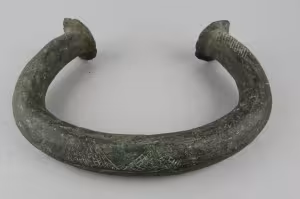
Akalaka host markets and carry out trade using the manilla as money. The native everyday Akalaka word for money is Ewai, Owai / Iwai / Awai. Cowries are also seldom used.
8. AKALAKA SPIRITUALITY
Akalaka Spirituality centers around Ale, the various emnations of Ama, the mande deity, and the various religious temples personalised and often commercialized for various judicial temple market needs. These are such as the Ekpeye Awalama and Amadi Alali which entertained pilgrimages from the Kalabari, and the Ama Di Ohna which entertained pilgrimage from the Igbos.
According to Talbot (1927) "As already mentioned, it is indicative of the reverence in which the Earth Goddess is held, that only the head chief of a town can aspire to be her priest. It is not without significance that the same rule holds with regard to the principal shrines of Amade Onhia. Only after pilgrimage to Ozozo may subsidiary lodges be erected, while the shrine of Ale is usually found nearby".
Akalaka spirituality also revolves around the concepts of nyama life force, ancestor veneration, the chi spirituality, and many tutelary, judicial and medicinal deities. An Akalaka religious society is the Obukele society.
Obukele Society
According to Talbot (1932)The Akalaka people form an exception to most peoples in the neighbourhood in that they appear to have no secret societies at all save for the Obukele club, which is itself only a semi-secret society. It is part of religious activities believed to ensure the multiplication of crops and herds, and to secure fruitfulness for human beings, animals and fishes. The adoption of christianity by the natives has however led to the extinction of the practice and is socio-cultural influence.
The ogbukele secret society has a
lodge in every village, which is often an imposing structure several stories high. In the dry season members perform a ceremony impersonating spirits. Ford & Jones (1950).
According to a chief of Abua. "Some of our people also join the Obukele Club. This does not cost much, only about two cases of gin. In olden days there were three grades to this society. (1) Edaba, members of which might stand near the clubhouse but not enter. (2) Ogbegum, members of which might go into the clubhouse, but not into the special part where Obukele dwells. (3) Araman, members of which wore white eagles’ feathers and might draw near to Obukele and see, or join in, the sacred dance. All these grades were abolished about fifteen years ago, at the same time as the institution called Oyil-ela." Talbot (1932).
9. Arts and Craft
|
Image

|
Image

|
Some of the most revered masks are the Akalaka bird masks, often associated with the Obukele society, and other socio-religious activities of the Akalaka people.
|
Image

|
Image

|
Arts and Craft Part 2
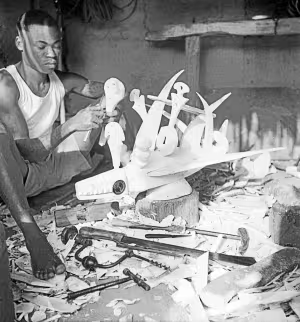
A photo of an Akalaka youth by G.I. Jones pictured above, making a figure mask for Owu masquerade with traditional tools of matchet, adze and knives and modern additions of plane, drill and hammer.
The Akalaka are master woodcrafters, applying their skills to everyday use items as well as items of religious purposes.
Items such as the Obukele masks are better pictured in their full colored glory (see below).

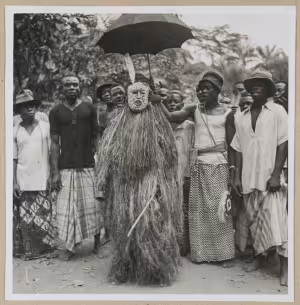
Some Akalaka masqerades are shown below, starting with a masquerade character called Akalaka, and akaleke on Jones Archive, representing the founding patriach of the Akalaka people as part of an Ikwerre Rumuji Owu masquerade play.
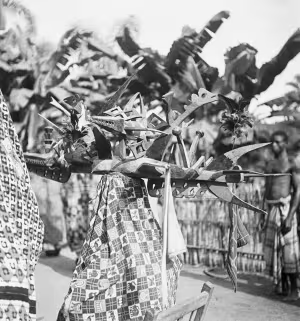
A close up view of the masquerade character called, Nwere Utobo (Hippo’s Wife) performing in the Akalaka-Ikwerre, Rumuji Owu play.
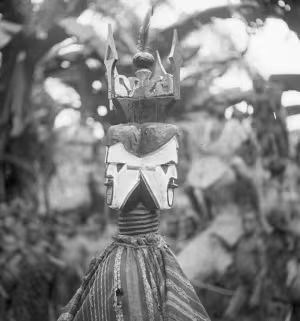
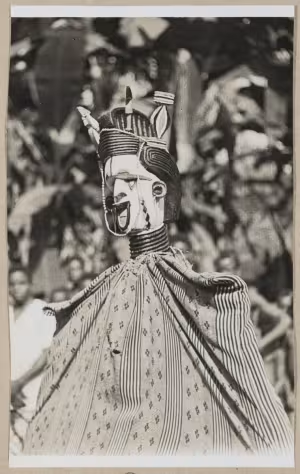
A close up view of the masquerade character called, Oyi Aro, Face of a lover ( from Oyi meaning lover and Aro an Akalaka/Edoid word meaning face), performing in the Akalaka-Ikwerre, Rumuji Owu play. Incorrectly labeled Oyiaro (Face like an Aro or Aro face). The masquerader is wearing a wooden, beautiful female, white face mask with an elaborate black incised coiffure with wooden geometric projections painted in different colours. The face consists of slit eyes, pointed nose and exaggerated open mouth and diamond shaped keloid markings on the cheek. Attached to the mask is a piece of rope or twine. The neck is coiled and attached to the mask is a cotton printed striped cloth. In the background are spectators and vegetation.
Home and Households
|
Image

|
Image

|
Above are a water tight vessel, and a wooden circular stool with two crossed and opposed arcs as supports.
Below are a pottery cylindrical vase with round bottom, flanged lip and relief decoration on upper part; broken; blackish ware with red slip. And a Carrying basket made by Akalaka-Etche. Made of split cane,with circular lid and flaring mouth and conical base.
|
Image

|
Image

|
Below are Akalaka cooking spoons.
|
Image

|
Image

|
Below are an Akalaka Hunting Bow an Arrow.
|
Image

|
Image

|
hhkdkjd
End Notes. An Akalaka Masquerade; Abbu or Alebo, tortoise.

dmdjld